Irish driver theory test

Irish Driver Theory Test (DTT): Free Lessons, Practice and Mock Tests

Free practice tests, full mock exams and lessons. Every answer cites the Irish law behind it.
  • Answers cite Irish law
  • Real test format
  • Free, no sign-up
Choose your theory test
  • 40questions
  • 45minutes
  • 35correct to pass
Source: Car/Tractor & Work Vehicles Theory Test, checked on 2026-09-15Start the car mock testPractice setsLessonsRoad signs
Free to use. No sign-up.

The driver theory test in Ireland is a multiple choice test taken on screen: the car test asks 40 questions in 45 minutes and you need 35 correct to pass, so 5 mistakes are allowed. Source: Citizens Information, page edited 6 May 2026, checked on 15 September 2026.

How it works

From your first lesson to a pass

Work through it in order, or jump straight to what you need.

Theory tests

Choose the test for your vehicle

How the test works
Why use this site

Practice you can check for yourself

Most practice sites ask you to trust their answers. Here every answer shows you where it comes from.

  • 1156cited practice questions
  • 356road signs explained
  • 9lessons
  • Every answer cites the law

    Each explanation names the Irish regulation or statute it rests on, with a link to the text on the Irish Statute Book.

  • The real test format

    Question counts, time limits and pass marks come from the official test description, checked and dated.

  • Checked, not guessed

    Where official sources disagree we show both. Where a figure is not published we say so instead of inventing one.

  • Free, with no sign-up

    Every lesson, practice set and mock test is open to use. Nothing is locked behind an account.

The official format

Four theory tests, four formats

Each figure below is taken from the official test description and dated with when we last checked it.

Theory test formats
TestQuestionsMinutesCorrect to pass
Car, tractor and work vehicle (BW)404535
Motorcycle and moped (AM)404535
Truck (C)10012074
Bus (D)10012074

Source: Car, tractor and work vehicle (BW), 2026-05-06, checked on 2026-09-15

Source: Motorcycle and moped (AM), 2026-05-06, checked on 2026-09-15

Source: Truck (C), 2026-05-06, checked on 2026-09-15

Source: Bus (D), 2026-05-06, checked on 2026-09-15

Try it now

Sample questions and answers

Pick an answer, then open the explanation to see the rule and where it comes from.

1 of 20
  1. Question 1

    How do penalty points normally differ when you pay a fixed charge instead of being convicted in court?

    • AThe fixed charge gives the lower points and conviction gives the higher pointsCorrect answer
    • BBoth outcomes always give the same points
    • CPaying the fixed charge means no points
    • DA court conviction always gives exactly twice the points listed for paying the fixed charge
    Show the answerHide the answer

    Correct answer: A

    Section 2(1) and (2) of the Road Traffic Act 2002 provides for the lower listed points when a fixed charge is paid and the higher listed points after a court conviction.

    Citation

    Source: Road Traffic Act 2002 (No. 12 of 2002), Section 2(1) and (2), checked on 2026-09-15.

  2. Question 2

    You are cycling and face a red cycle symbol at cycle traffic lights. The road looks clear. What must you do?

    • AGo on, because a red cycle symbol applies only to e-scooters
    • BGo on if the road is clear
    • CTreat the lights as advice and continue with care
    • DDo not go past the lights or the stop lineCorrect answer
    Show the answerHide the answer

    Correct answer: D

    A red cycle symbol means cyclists, e-moped users and e-scooter users must not go past the lights or the stop line, even if the road looks empty. Article 47B of the Road Traffic (Traffic and Parking) Regulations 1997 does not treat cycle lights as advice or limit the red symbol to e-scooters.

    Citation

    Source: Road Traffic (Traffic and Parking) Regulations 1997 (S.I. No. 182 of 1997), Article 47B, as substituted by S.I. No. 473 of 2025, reg. 2(q), checked on 2026-09-15.

  3. Question 3

    A driver ahead extends the right arm with the palm down and moves it slowly up and down. What are they signalling?

    • AThey intend to slow down or stopCorrect answer
    • BThey intend to turn right
    • CThey intend to turn left
    • DThey want you to overtake
    Show the answerHide the answer

    Correct answer: A

    The hand-signal rule in article 18 and Table A assigns a slowly raised and lowered right arm to slowing down or stopping.

    Citation

    Source: Road Traffic (Traffic and Parking) Regulations 1997 (S.I. No. 182 of 1997), Article 18(1) and Second Schedule, Table A, checked on 2026-09-15.

  4. Question 4

    At a pedestrian crossing controlled by traffic lights, the amber light is flashing and a pedestrian is partway across. What must you do?

    • AGo on only after yielding to the pedestrian already crossingCorrect answer
    • BDrive on as if the light were green
    • CSound the horn so the pedestrian returns to the footpath
    • DGo on once the pedestrian has passed the centre of the road
    Show the answerHide the answer

    Correct answer: A

    When the amber lamp of standard traffic lights flashes, you may pass the lights or stop line only after yielding to a pedestrian who has already started to cross. Article 30(4) of the Road Traffic (Traffic and Parking) Regulations 1997 does not treat flashing amber as green or cut priority at the centre line.

    Citation

    Source: Road Traffic (Traffic and Parking) Regulations 1997 (S.I. No. 182 of 1997), Article 30(4), as substituted by S.I. No. 473 of 2025, reg. 2(g), checked on 2026-09-15.

  5. Question 5

    You approach a hatched area that separates merging traffic streams. May you drive into it?

    • ANo, a vehicle must not enter the hatched areaCorrect answer
    • BYes, when changing lanes
    • CYes, when the markings look clear
    • DYes, when traffic is slow
    Show the answerHide the answer

    Correct answer: A

    Article 26 of the Road Traffic (Traffic and Parking) Regulations 1997 prohibits a vehicle from entering the marked hatched area used where traffic streams merge or diverge.

    Citation

    Source: Road Traffic (Traffic and Parking) Regulations 1997 (S.I. No. 182 of 1997), Art. 26, checked on 2026-09-15.

  6. Question 6Road sign

    At roadworks where one lane is closed, a worker holds this sign facing your traffic. What does it tell you?

    • AA speed limit of 20 km/h
    • BYield right of way to traffic on the major road ahead
    • CStop, and stay stopped while the disc is shownCorrect answer
    • DTraffic may go on past the roadworks
    Show the answerHide the answer

    Correct answer: C

    The picture shows the STOP disc used at roadworks. Regulation 32(1) of the Road Traffic (Traffic Signs) Regulations 2025 provides that when it faces your stream of traffic at roadworks, traffic must stop before the sign and stay stopped while it is shown.

    Citation

    Source: Road Traffic (Traffic Signs) Regulations 2025 (S.I. No. 433 of 2025), Regulation 32(1), (2); Schedule 2, Part 5, checked on 2026-09-16.

  7. Question 7

    On a protected road you take the continuous white line on the right for a lane line. What is it?

    • AThe centre of the carriageway
    • BA hard shoulder
    • CThe right-hand edge of the carriagewayCorrect answer
    • DA no overtaking line
    Show the answerHide the answer

    Correct answer: C

    Under Regulation 78 of the Road Traffic (Traffic Signs) Regulations 2025, as substituted, a continuous white line marks the right-hand edge of the carriageway of a motorway, a protected road or a dual carriageway. A lane line is a broken white line under a different regulation. This edge line is not the centre, a hard shoulder, or a no overtaking marking.

    Citation

    Source: Road Traffic (Traffic Signs) Regulations 2025 (S.I. No. 433 of 2025), Regulation 78, as substituted by S.I. No. 205 of 2026, reg. 3(d), checked on 2026-09-15.

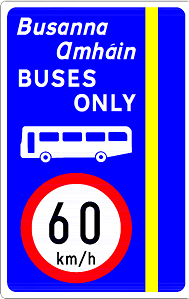
  8. Question 8Road sign

    On a busy motorway, this sign is lit up beside the lanes. How should you read it?

    • AVehicles with at least the axles shown must not use the right-hand lane
    • BThe height of the structure ahead, in metres
    • CA bus priority facility is in operationCorrect answer
    • DOvertaking is not allowed
    Show the answerHide the answer

    Correct answer: C

    That is the bus priority facility sign. Regulation 10A, added to the Road Traffic (Traffic Signs) Regulations 2025 by S.I. No. 205 of 2026, provides that with the wide continuous yellow line it indicates a bus priority facility, and it is displayed when the facility is in operation.

    Citation

    Source: Road Traffic (Traffic Signs) Regulations 2025 (S.I. No. 433 of 2025), as amended by the Road Traffic (Traffic Signs) (Amendment) Regulations 2026 (S.I. No. 205 of 2026), Regulation 10A(1), inserted by S.I. No. 205 of 2026; Schedule 1, Part 8, checked on 2026-09-16.

  9. Question 9Road sign

    At a quiet crossroads this sign faces you. Nothing is coming. May you go straight on instead?

    • ANo, traffic must turn right hereCorrect answer
    • BYes, the arrow is advice when the junction is empty
    • CYes, if you signal that you will go straight on
    • DYes, because the sign only means the road bends right
    Show the answerHide the answer

    Correct answer: A

    Under Regulation 4 of the Road Traffic (Traffic Signs) Regulations 2025, the turn right sign requires traffic to turn right at that place. An empty junction, a signal, or reading it as a bend warning does not lift the duty.

    Citation

    Source: Road Traffic (Traffic Signs) Regulations 2025 (S.I. No. 433 of 2025), Regulation 4(1)(a); Schedule 1, Part 1, checked on 2026-09-15.

  10. Question 10

    Must you stop at a stop sign when a quiet rural junction has clear views and no traffic in sight?

    • ASlow to walking pace and continue
    • BStop only when traffic is approaching
    • CContinue after checking both directions
    • DStop before the stop signCorrect answer
    Show the answerHide the answer

    Correct answer: D

    The stop-sign rule in article 20 requires a full stop in advance of the stop sign, and in advance of the stop line where one is marked, even when the junction looks completely clear.

    Citation

    Source: Road Traffic (Traffic and Parking) Regulations 1997 (S.I. No. 182 of 1997), Article 20(1), (2), checked on 2026-09-15.

  11. Question 11

    What braking distance does RSA guidance give at 60 km/h in dry conditions?

    • A12 metres
    • B21 metresCorrect answer
    • C33 metres
    • D36 metres
    Show the answerHide the answer

    Correct answer: B

    RSA guidance in the Rules of the Road gives 21 metres as the braking part of the 33 metre total at 60 km/h.

    Citation

    Source: Rules of the Road, Road Safety Authority, Revision No. 9, May 2026 (guidance, not law), Stopping distances in dry conditions, Table 5, PDF page 125, checked on 2026-09-15.

  12. Question 12

    What is the default speed limit on a motorway when no lower road or vehicle limit applies?

    • A80 km/h
    • B90 km/h
    • C100 km/h
    • D120 km/hCorrect answer
    Show the answerHide the answer

    Correct answer: D

    Section 8(1) of the Road Traffic Act 2004 sets the motorway default at 120 km/h. A special, roadworks, variable or vehicle limit can require a lower speed.

    Citation

    Source: Road Traffic Act 2004 (No. 44 of 2004), s. 8(1), checked on 2026-09-15.

  13. Question 13

    Two STOP discs are mounted back to back at roadworks. Which traffic do they stop?

    • AOnly the first vehicle in each queue
    • BThey show STOP and GO at once, so both streams may go
    • CThey are advisory panels only
    • DTwo streams at onceCorrect answer
    Show the answerHide the answer

    Correct answer: D

    Regulation 32 of the Road Traffic (Traffic Signs) Regulations 2025 provides that where two streams of traffic must stop and remain stopped, two STOP discs may be mounted back-to-back as a single panel facing those streams. The panel does not show both meanings at once, it is not limited to the first vehicle, and it is not advisory.

    Citation

    Source: Road Traffic (Traffic Signs) Regulations 2025 (S.I. No. 433 of 2025), Regulation 32(6), checked on 2026-09-15.

  14. Question 14

    What appearance must the L plates on your learner car have?

    • AA white letter L on a red background, 15 cm high
    • BA red letter L on a white background, 10 cm high
    • CA black letter L on a yellow background, 15 cm high
    • DA red letter L on a white background, at least 15 cm highCorrect answer
    Show the answerHide the answer

    Correct answer: D

    Regulation 17(6)(b)(iii)(I) of the Road Traffic (Licensing of Drivers) Regulations 2006 requires a red L on white, with the letter at least 15 cm high.

    Citation

    Source: Road Traffic (Licensing of Learner Drivers) Regulations 2007 (S.I. No. 719 of 2007), Regulation 2(b)(ii), substituting Regulation 17(6)(b)(iii)(I) of S.I. No. 537 of 2006, checked on 2026-09-15.

  15. Question 15

    What is the maximum prison term on conviction for drink or drug driving under section 4?

    • A3 months
    • B12 months
    • C6 monthsCorrect answer
    • D2 years
    Show the answerHide the answer

    Correct answer: C

    Road Traffic Act 2010, section 4 sets a maximum of 6 months in prison, and the court may also impose a fine.

    Citation

    Source: Road Traffic Act 2010 (No. 25 of 2010), Section 4(5), checked on 2026-09-15.

  16. Question 16Road sign

    You are on horseback on a rural local road and meet this sign. What applies?

    • AOnly ridden horses on market days are caught
    • BThe sign catches dogs on a lead, not horses
    • CYou must not go past the signCorrect answer
    • DThe sign applies only on market days
    Show the answerHide the answer

    Correct answer: C

    Regulation 18 of the Road Traffic (Traffic Signs) Regulations 2025 provides that a person riding, leading or driving a horse or animal, or in charge of one, must not go past the sign. A rider on horseback is caught. The sign is not limited to market days.

    Citation

    Source: Road Traffic (Traffic Signs) Regulations 2025 (S.I. No. 433 of 2025), Regulation 18(1), (4), checked on 2026-09-15.

  17. Question 17Road sign

    What does this sign tell drivers?

    • APeople riding, leading or driving animals must not go pastCorrect answer
    • BVehicles must not turn right
    • CVehicles must not go straight ahead
    • DA tram lane
    Show the answerHide the answer

    Correct answer: A

    That is the no animals sign. Regulation 18 of the Road Traffic (Traffic Signs) Regulations 2025 provides that a person riding, leading or driving a horse or other animal, or in charge of one, must not go past it. Cats and dogs do not count as animals for this sign.

    Citation

    Source: Road Traffic (Traffic Signs) Regulations 2025 (S.I. No. 433 of 2025), Regulation 18(1), (4); Schedule 2, Part 1, checked on 2026-09-16.

  18. Question 18Road sign

    At a junction on a local road, this sign faces you. What manoeuvre must you not make past it?

    • AThe sign allows a right turn when nothing is coming
    • BThe sign allows a right turn for a quick drop off
    • CThe sign applies to large vehicles only
    • DTurning right past the signCorrect answer
    Show the answerHide the answer

    Correct answer: D

    Regulation 14 of the Road Traffic (Traffic Signs) Regulations 2025, Schedule 2, Part 1, makes the no right turn sign a prohibitory sign: you must not turn right past it. An empty junction, a short drop off, or vehicle size does not lift the prohibition.

    Citation

    Source: Road Traffic (Traffic Signs) Regulations 2025 (S.I. No. 433 of 2025), Regulation 14(2)(a); Schedule 2, Part 1, checked on 2026-09-15.

  19. Question 19

    You are on a cycle street behind a cyclist. Where may you next overtake?

    • AAnywhere the road ahead is clear
    • BAfter you pass the end of cycle street signCorrect answer
    • CWhere the cyclist waves you on
    • DWhere you can overtake below 30 km/h
    Show the answerHide the answer

    Correct answer: B

    The cycle street rules last until the end of cycle street sign. Until then you stay behind people on pedal cycles, e-mopeds and e-scooters. Article 14B of the Road Traffic (Traffic and Parking) Regulations 1997 does not let a wave, a clear road, or a low speed bring the overtaking ban to an end early.

    Citation

    Source: Road Traffic (Traffic and Parking) Regulations 1997 (S.I. No. 182 of 1997), Article 14B, inserted by S.I. No. 473 of 2025, reg. 2(d), checked on 2026-09-15.

  20. Question 20

    A rider has held a full motorcycle licence for 7 years. What blood alcohol limit applies while riding?

    • A20 mg per 100 ml of blood
    • B67 mg per 100 ml of blood
    • C80 mg per 100 ml of blood
    • D50 mg per 100 ml of bloodCorrect answer
    Show the answerHide the answer

    Correct answer: D

    Road Traffic Act 2010, section 4 applies the 50 mg blood limit because a long-term motorcycle licence holder is not treated differently.

    Citation

    Source: Road Traffic Act 2010 (No. 25 of 2010), Section 4(2)(a), (3)(a) and (4)(a), checked on 2026-09-15.

Ready to see where you stand?

Sit a full mock test in the real format of the Car/Tractor & Work Vehicles Theory Test: 40 questions in 45 minutes. At the end you see exactly which answers to review.

Start a mock test